
Trace Brambleton Previous Residents by Era
A Brambleton address has a recent planned-community layer and a much older Loudoun County land layer. Start with the recorded parcel path for recent previous residents, then move to the parent tract when a modern lot disappears from older records. The sources below have different coverage and purposes. They can establish a recorded party, an address clue, a historical community context, or a construction date. They should not be combined into an unsupported claim that every listed person lived at the same modern address.
| Source | Years it covers | Where held | What it shows |
|---|---|---|---|
| Clerk land records | 1757-present | Loudoun Clerk, PAX, public kiosk, or mail | Recorded parties, instruments, legal descriptions, plats, and references |
| Federal census microfilm | 1810-1930 for Loudoun | Thomas Balch Library | Names in a district or locality paired with a decade |
| City and town directory leads | Verified 1911 and 1962 leads | Thomas Balch and onsite catalog work | Historical names and town-period clues, not a complete Brambleton run |
| Newspapers, cemetery, and house files | Collection-specific | Thomas Balch Library | Notices, death or burial associations, maps, and local history context |
| Residential permit evidence | 2010 through prior year; reports from 2015 | County service and reports | Work, issue, final, project, or structure dates |
Begin with land records when the question is about the lot or its earlier tract. Use the library collections after the deed trail supplies a name, locality, road, or decade. Permit data belongs later in the process because it dates work, not a person.
Start Brambleton Previous Residents With a PIN
The first task is to turn the modern street address into stable parcel identifiers. Search the Loudoun Real Property Assessment Database by number, street, and unit when needed. Record the current PIN or tax-map reference, legal description, subdivision, sales or deed information, and the date of the assessment result. The assessment system is updated weekly. Its owner or taxpayer and mailing fields are valuable leads, but they are not evidence of current or past residence at the situs address.
Next, open the address in Loudoun WebLogis. Choose the autocomplete result, inspect the parcel, and save the map context. The parcel panel can show a PIN, tax map, plat number or title, project number, parent fields, subdivision, and town or ZIP. The inspected Brambleton sample identifies BRAMBLETON LANDBAY 2 and Ashburn, VA 20148. A landbay is a useful bridge between a modern lot, its plat, and related development records.
Current Brambleton homes began in 2001. That does not limit the historical search to the modern community. Earlier records may describe a larger rural tract by acreage, a nearby landowner, a road, a stream, or a district. Preserve the modern PIN, landbay, plat, and legal description before moving backward.
Follow Brambleton Previous Residents Through PAX
The Loudoun TrakRecord/PAX portal is the online land-record endpoint. Use the latest recorded owner or grantee and deed reference from the parcel result to find the latest transfer. Then work from the seller named in that transfer to the seller's earlier acquisition, checking the legal description, lot, landbay, acreage, or prior reference each time. The objective is the chain for the same physical land, not a match on a similar street name alone.
The backward chain is methodical. Record enough detail at every step to return to the underlying instrument if a name, parcel boundary, or description changes.
- Capture the current assessment PIN, tax map, subdivision or landbay, legal description, and latest deed reference.
- Find the latest relevant deed or instrument in PAX by grantee, grantor, date, or reference. Check the image or Clerk file for the parcel details.
- Search the prior grantor as a grantee to locate that party's earlier acquisition. Record the instrument type, recording date, document or book and page, and legal description.
- Repeat the comparison until the modern lot becomes a parent tract or the chain reaches the needed period. Use plats to account for lot creation.
- When an image is unavailable remotely, use the Clerk's kiosk or send a specific mail request with the reference, copy size, certification choice, payment, and self-addressed stamped envelope.
These terms keep the records trail readable when instruments use formal land-record language.
- Grantor
- The party conveying an interest in a recorded instrument.
- Grantee
- The party receiving that recorded interest. In a backward search, a prior grantor may be located as a grantee on an earlier deed.
- Chain of title
- The sequence of recorded instruments used to trace interests in the same property.
- Legal description
- The lot, tract, boundary, or plat wording that identifies land more reliably than a modern street label.
A view of Loudoun Land Records Remote Access shows the separate remote index and image-access route.
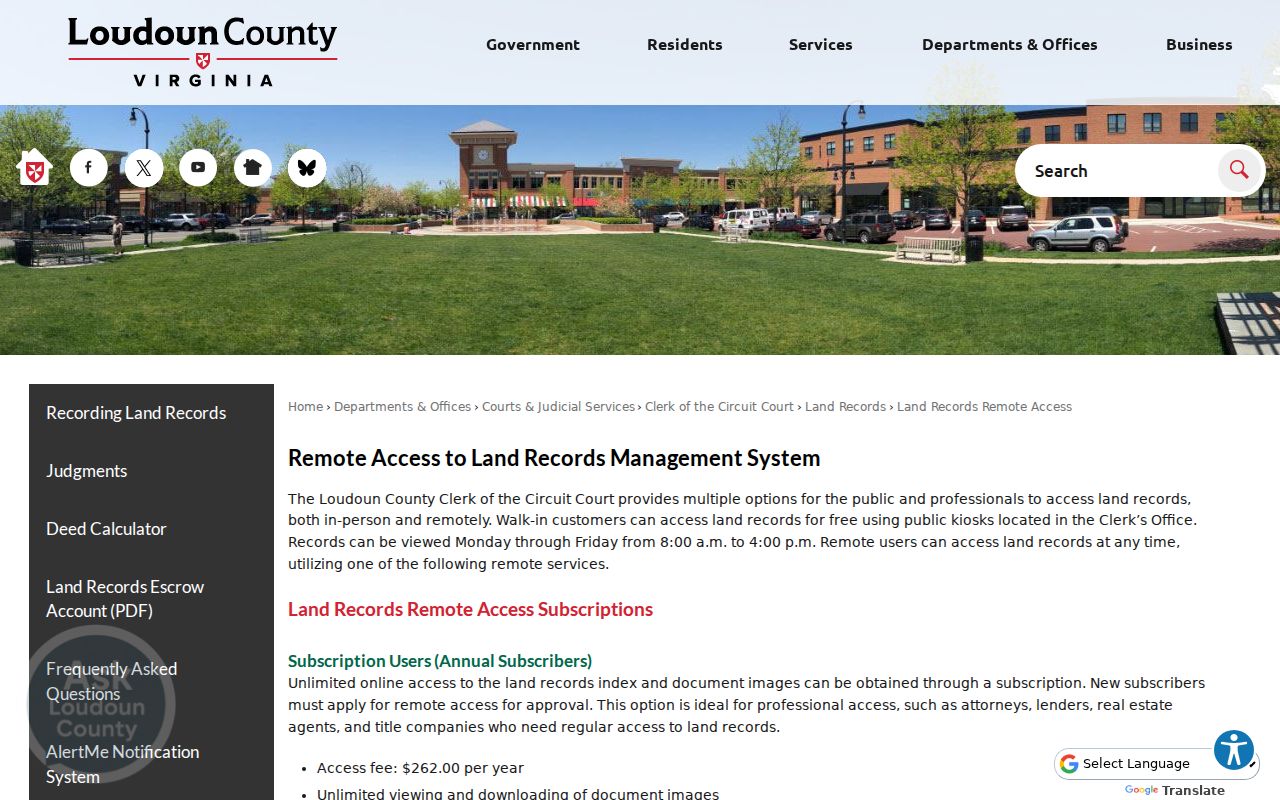
The remote service can start a chain, but an image, public terminal, or tailored Clerk request may be needed to confirm the full description.
Why Brambleton Previous Residents Reach 1757
Loudoun County was formed in 1757 from Fairfax County, and the Clerk describes its court-record collection from 1757 as unusually complete. The county says the surviving records escaped the fire, war, and environmental losses that affected some Virginia repositories. That longevity is an important story for Brambleton previous residents: a community with homes beginning in 2001 can still lead back through a parent tract to earlier deeds, wills, probate, court books, and tax records.
Historic Records & Deed Research covers deeds, deeds of trust, assignments, certificates of satisfaction, judgments, subdivision plats, and other real-property instruments from 1757 to the present. The office is at 18 East Market Street, Leesburg, with public counter hours Monday through Friday from 8:00 a.m. to 4:00 p.m. Staff can help visitors access material, but they do not perform legal research or interpret documents.
Remote users have several channels. The occasional-user index is free, while images are purchased individually. The inspected subscriber option was $262 per year for one account and includes index and image access. Public kiosks at the Clerk's office are free. Mail requests go to Clerk, Attn: Historic Records, P.O. Box 550, Leesburg, VA 20178. Image and copy fees can change, so verify them when ordering.
Note: A long county record span supports parent-tract research, not a claim that a modern Brambleton lot existed in every earlier record.
Match Brambleton Past Residents to Plats
Plats explain the transition from a parent tract to modern Brambleton lots. In the deed chain, look for subdivision plats, legal-description changes, lot and section labels, landbay references, acreage changes, and earlier instrument references. A plat maps how a larger parcel was divided and can help test whether an older deed covers the land beneath a current address. A certificate of satisfaction may show that a deed of trust was released, but it does not itself transfer title.
No validated Brambleton house-number conversion or road-renumbering schedule was located. When an old road or address does not match a current one, compare the plat, legal description, road-centerline layer, aerial imagery, permit fields, and county address records. Loudoun Mapping & GIS accepts address applications and checklists electronically or by mail through the Address Coordinator route. Ask for written confirmation when a historic address relationship matters.
Date Brambleton Previous Residents With Permits
Permit information is a date layer, not a resident layer. Loudoun's residential building-permit service begins in 2010 and runs through the prior year. Captured fields include permit number, PIN, issue month and year, street address, unit type, project or subdivision, ZIP, town, and zoning. The issued permit reports begin in 2015 and can help compare a development phase, construction event, or later alteration with the parcel's recorded history.
A permit issue date, final date, or inspection record does not prove that a person moved in. Before 2010, use the deed, plat, assessment creation, county records, or archival material rather than implying the permit layer is complete. Keep construction evidence separate from evidence about previous residents.
Find Brambleton Previous Residents in Archives
Thomas Balch Library in Leesburg is the key historical layer after a parcel trail supplies an owner, tract, locality, or decade. It is a public, non-circulating research library with deeds and wills, federal census, historic house files, maps, newspapers, cemetery records, tax rolls, vital indexes, and local-history collections. Its Loudoun census microfilm runs from 1810 through 1930. Pair a census decade with the former tract, rural district, and known owner rather than assuming the modern CDP label will appear.
For past residents, the verified city-directory leads are a 1911 Leesburg directory reference and a 1962 Hill Directory Company reference reported by a secondary academic source. Neither establishes a complete Brambleton directory sequence or a reverse-address run. The Brambleton city directory material gives the collection context. Ask Balch staff to confirm a volume and call number before drawing a street-level conclusion.
The library also has Heritage Hub for obituary and death-notice research, a cemetery database with more than 200 local cemeteries, a newspaper index, and historic house files. An obituary can supply a relationship or prior-address lead; a cemetery record can support a death or burial association. Neither proves residence at a specific address without other records. The remote reference service offers bounded help, including 15 minutes of free general research for eligible remote patrons, up to three requests each month, and paid general research listed at $30 for up to one hour and ten copies. Onsite access or an appointment remains the route for deeper collection work.
For statewide backup, the Library of Virginia Loudoun microfilm catalog lists land, court, tax, road, vital, marriage, fiduciary, will, election, and town record categories. Use a former tract owner or Loudoun locality as well as the modern Brambleton label.
Weigh Brambleton Previous Residents Evidence
Build an evidence ladder for each possible past resident. Start with the parcel and its legal description. Add the recorded instrument and date. Then compare a census district, directory clue, newspaper notice, cemetery entry, or historic map only when the name, place, and time are consistent. The owner, voter, deed party, directory entry, and occupant are different identity claims. A strong address history labels each source instead of smoothing those differences away.
Virginia records also have privacy boundaries. Protected voter residence addresses can be substituted or withheld, and the Virginia Address Confidentiality Program protects qualifying participants. A Clerk record may be public while another record category remains restricted. For a county record request, use Virginia FOIA with a specific office, record type, time range, address, PIN, or document number. The five-working-day initial response rule does not override protected information.
Lawful use. Brambleton previous-resident research is for family history, house history, estate questions, and personal curiosity. Never use records to stalk, harass, intimidate, or harm a living person.